#IAB Europe publishes a playbook for AI access and licensing
On November 26, 2026, IAB Europe, the European association for digital advertising, published the Publisher Playbook for the Agentic Web. Its Publisher Content & AI Task Force and AI Working Group wrote it, with feedback from a working group at BVDW, the German digital economy association. The press release calls it an interactive tool to assess your position, decide how AI systems can access your content, choose how to get paid and plan your first 90 days.
The audience is publisher teams: commercial, editorial, legal, product and ad operations. IAB Europe is clear about the limits.
It sets out options and questions to consider. It does not recommend a single strategy, prices or contract terms.
The tool uses scores, sliders and checklists, and the inputs stay in your browser, according to the announcement.
#One access rule for each AI use
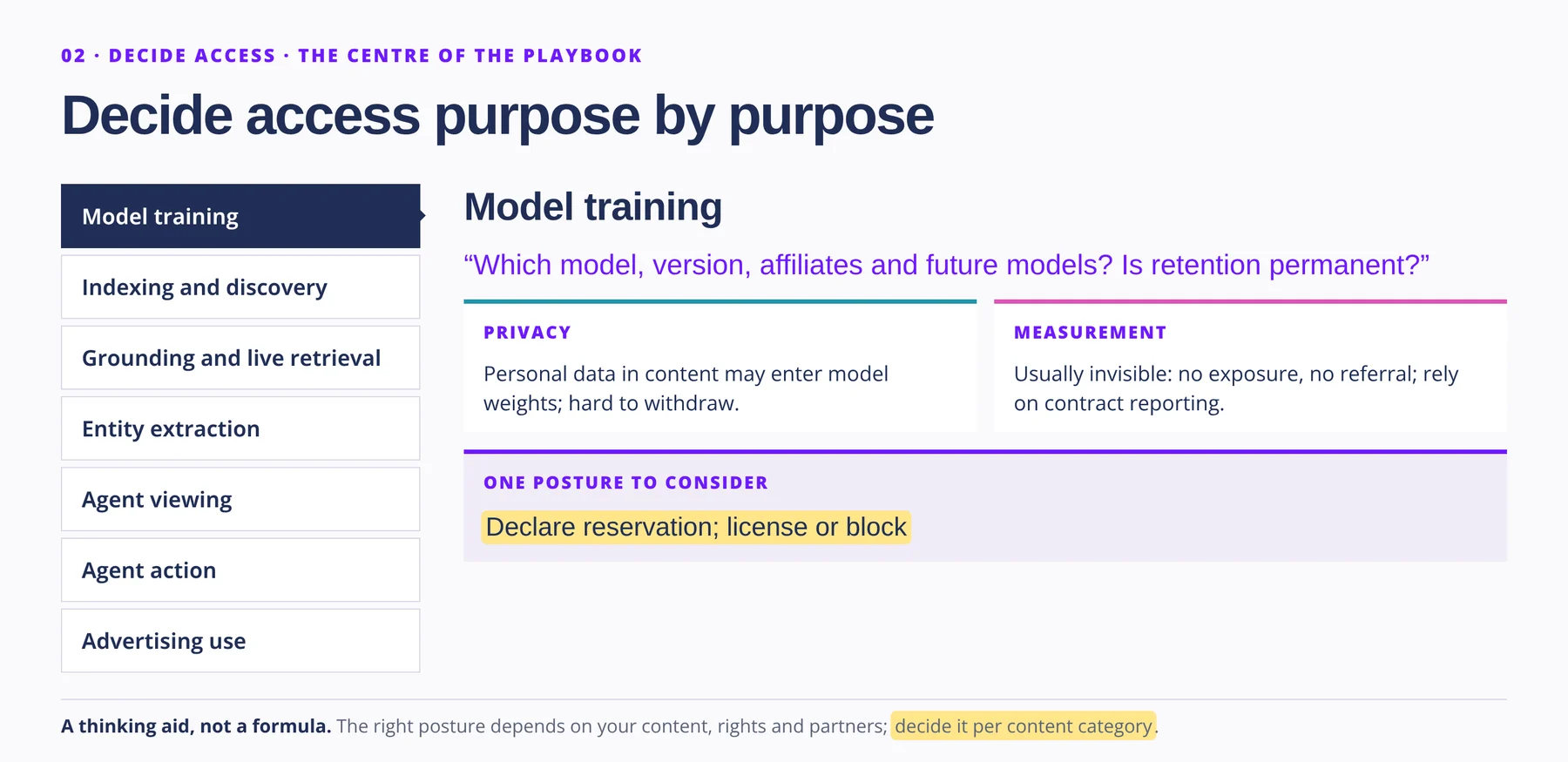
The announcement says the playbook covers how to classify automated traffic and how to set access rules "for each AI use, from model training to agent actions". The playbook itself has 22 slides. Its slide "Decide access purpose by purpose" lists the 7 uses, a question for each and one posture to consider:
| AI use | Question for the AI operator | One posture to consider |
|---|---|---|
| Model training | Which model, version, affiliates and future models, and is retention permanent? | Declare a reservation, license or block |
| Indexing and discovery | Does the result give links, summaries or substitution? | Open, or only listed crawlers |
| Grounding and live retrieval | What is retrieved, shown, kept, cited and reported? | Metered, or under contract |
| Entity extraction | Which facts or listings are lifted out, and where are they reused? | Licensed feed, or reserved |
| Agent viewing | Does an agent read the page for one user? | Allow when identified, measure apart |
| Agent action | Who controls the user, transaction, liability and outcome data? | Tool or API under contract |
| Advertising use | Are editorial and ad uses kept apart and disclosed? | Only under explicit agreement |
Between open and block, the playbook places 5 more postures: declare, allow list, rate limits, metered and contract only. Its rule is to decide visibility, access and monetisation for each content category, "rather than one 'AI policy' for the whole site".
Our read: the split matches how the large operators already name their crawlers. OpenAI uses GPTBot for training, OAI-SearchBot for search and ChatGPT-User for fetches a user starts. Google's Google-Extended token covers training and AI products outside Search. A per-use policy is something you can partly write in robots.txt today. Our guide to training bots and search bots shows which token does which job.
#Why robots.txt is only the first step
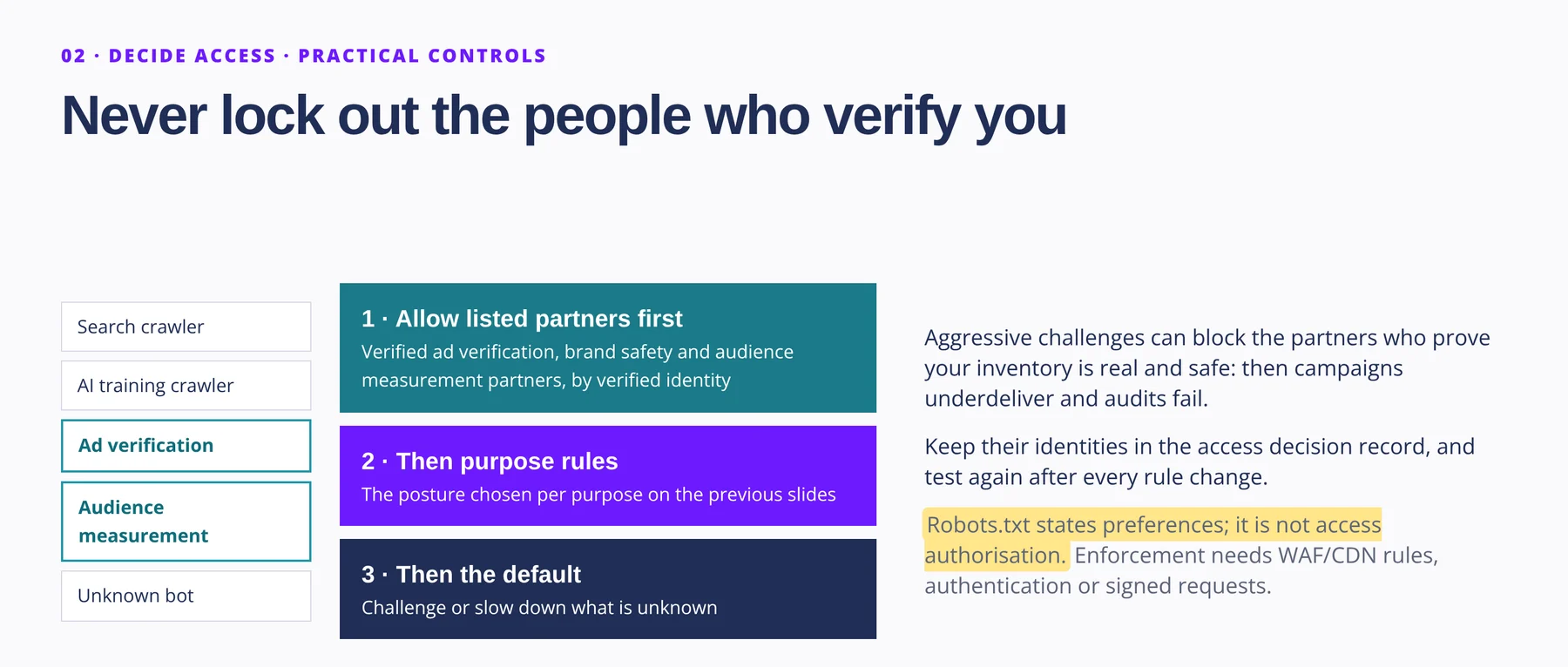
The playbook has a slide on the side effects to weigh before blocking. Another slide gives an order of rules: first allow verified ad verification, brand safety and audience measurement partners, then apply your rule for each AI use, then challenge or slow down unknown traffic. A block that catches those partners can make campaigns underdeliver and audits fail.
The same slide is direct about robots.txt. It says the file "states preferences" and "is not access authorisation". Enforcement needs firewall or CDN rules, authentication or signed requests. The playbook also asks publishers to keep agent visits out of audience and billable counts, because an agent that reads a page for one person is not a human impression.
#A ratio to track before you license
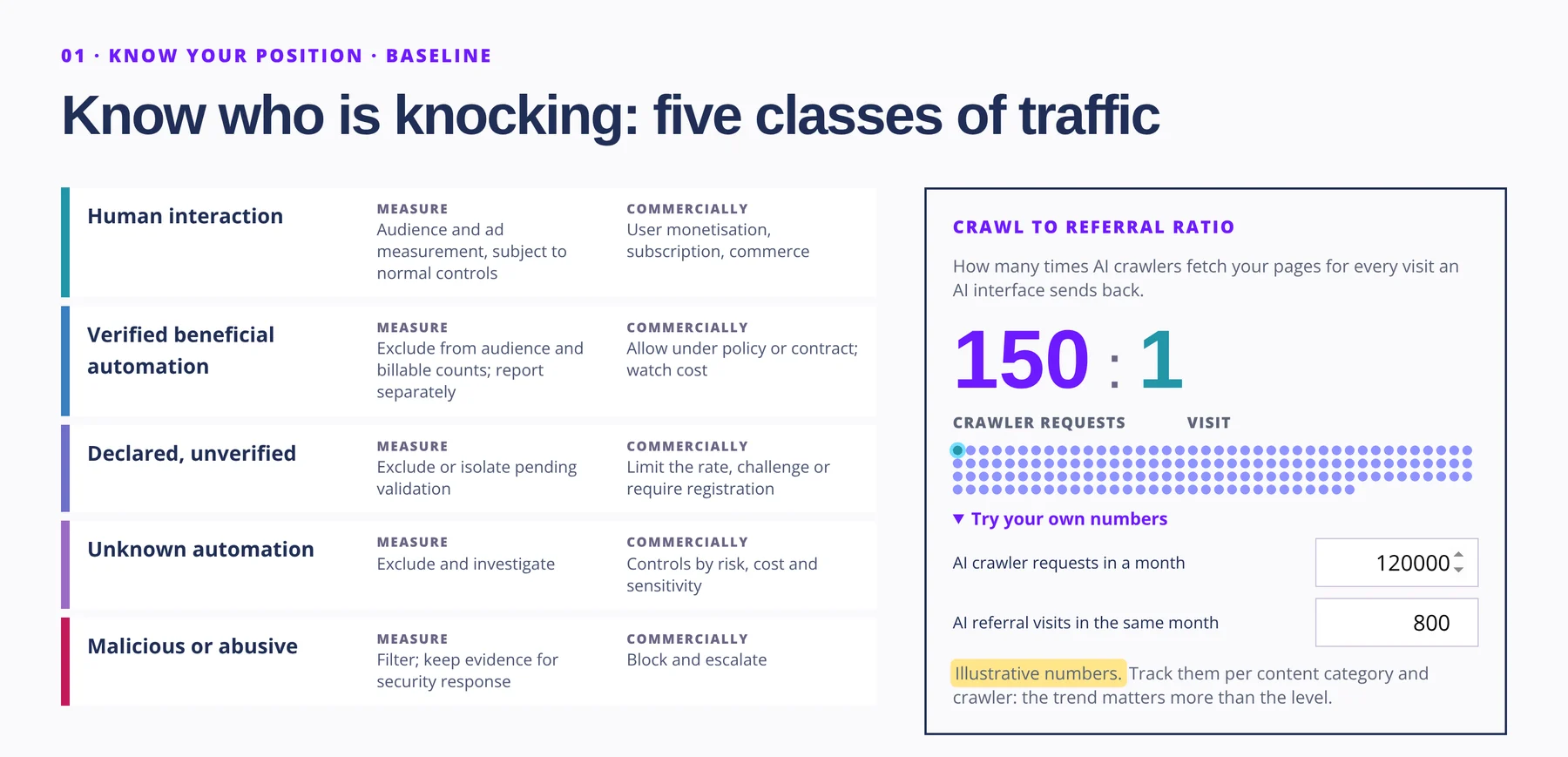
The playbook's calculator compares AI crawler requests with the visits that AI services send back. Its default example is 120,000 crawler requests in a month against 800 AI referral visits, a ratio of 150 to 1. The slide labels these numbers as illustrative. It asks publishers to track the ratio per content category and per crawler, because the trend matters more than the level.
The licensing chapter compares 6 models, from a flat fee to payment per lead or sale, and each one depends on something the publisher must measure. A usage license needs logging and audit, for example. The 13 due-diligence questions include what stays with the AI company after the contract ends, embeddings included.
#What to check
- In your server logs, count requests from each AI crawler and compare them with AI referral visits in your analytics, by section of the site. Our guide to log file analysis shows how to separate the crawlers.
- In robots.txt, look for one group that blocks or allows all AI bots together. If you want training and search treated differently, give
GPTBotandOAI-SearchBot(orGoogle-ExtendedandGooglebot) their own groups. - In your firewall or CDN bot rules, check that your ad verification and measurement vendors are on an allow list before any AI rule runs.
- In any AI licensing draft, check that the contract names which of the 7 uses it covers. The playbook's third due-diligence question is "Purpose: which of the seven, named".
#What IAB Europe doesn't say
- The playbook names no crawler and no robots.txt token. It does not map its 7 uses to the tokens that AI operators publish, and its slide on what the market still needs lists purpose granularity in robots.txt as a gap.
- It does not say at what crawl to referral ratio a publisher should block, meter or ask for a license.
Sources
- IAB Europe's Publisher Playbook for the Agentic WebIAB Europe, November 26, 2026
- IAB Europe Launches New Playbook to Help Publishers Navigate the Agentic WebIAB Europe, November 26, 2026
- Publisher Playbook for the Agentic WebIAB Europe