#OpenAI grows the ChatGPT-User list to 367 entries
On November 25, 2026, OpenAI published a new version of chatgpt-user.json, the list of address blocks that ChatGPT-User connects from. PPC Land reported that it added 130 blocks of 16 addresses, 2,080 addresses in all, and removed none. A monitoring tool run by the search consultancy Merj caught the change first and counted 129 blocks. OpenAI made no announcement, and its crawler documentation still links the file with no note of a change.
#What changed in chatgpt-user.json
The file has two fields: a creationTime and a list of IPv4 blocks. The new version's creationTime is 07:18:51 on November 25, 2026, with no time zone.
| Measure | Earlier copy | File dated November 25, 2026 |
|---|---|---|
| Entries | 237 | 367 |
| Blocks of 16 addresses | 236 | 366 |
| Larger blocks | 1, of 65,536 addresses | The same 1 |
| All listed addresses | 69,312 | 71,392 |
The November 25 column is our own count of the live file, read on November 26, 2026. The earlier column is PPC Land's count of a public mirror of the list on GitHub, which still held the old version on November 25.
That one large block holds about 92% of all listed addresses, so the total rose only 3%. Counted in blocks of 16, which is how the list has been growing, it rose 55%. The new blocks are spread out: PPC Land found 104 of them standing alone and the other 26 in 11 short runs, across 76 different /16 ranges. Our read: a rule that allows a few address ranges picked by hand won't cover them. Only the full list does.
#Why the address list is the check that counts
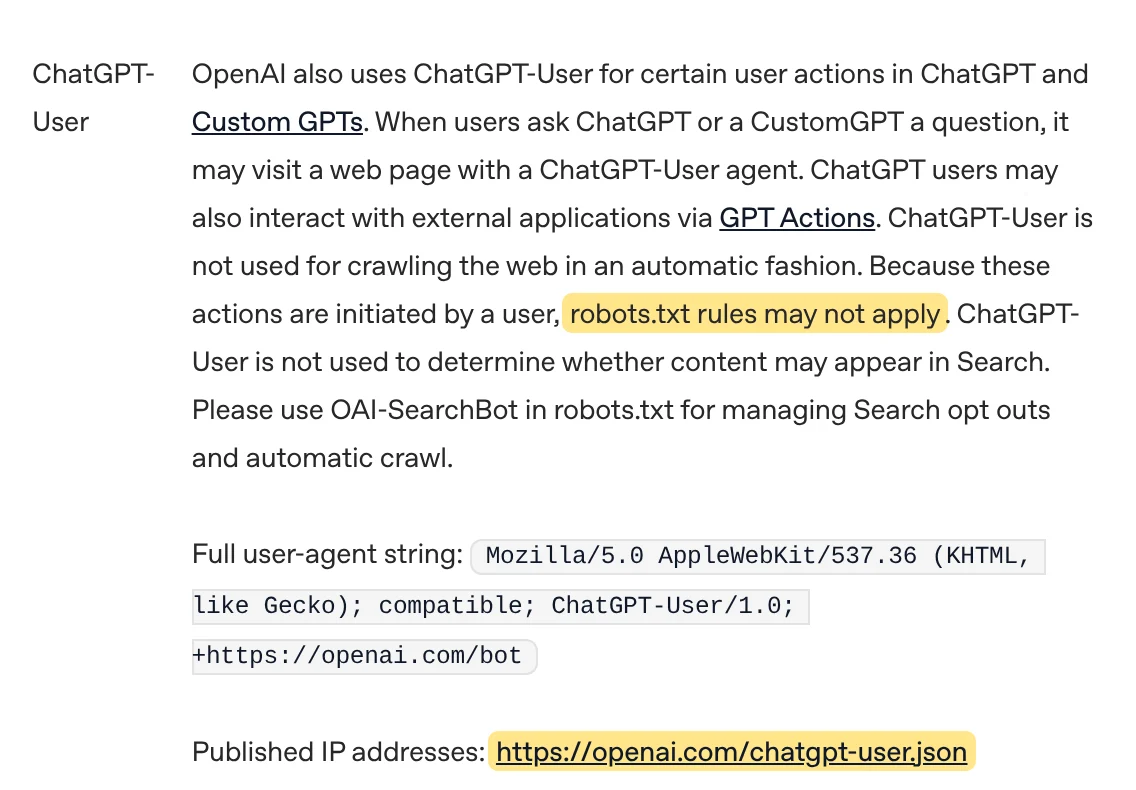
OpenAI's documentation says ChatGPT-User visits a page when someone asks ChatGPT or a Custom GPT a question, and that it is "not used for crawling the web in an automatic fashion". The same entry adds: "Because these actions are initiated by a user, robots.txt rules may not apply." In the test of AI search fetchers we covered on November 25, ChatGPT-User never asked for robots.txt at all.
For ChatGPT-User, the documentation gives a full user agent string and the address file, and no reverse DNS name or other method. Any client can send the string. Our read: a check against the file is the only documented way to tell a real ChatGPT visit from one that borrows the name.
A stale copy fails in one direction this time: real visits from the new blocks look fake, and a rule that blocks unverified ChatGPT-User traffic turns them away. Apple's Applebot list also dropped blocks after it grew, so an old copy of that one went wrong both ways.
#The OAI-SearchBot and GPTBot files stay the same
OpenAI publishes a separate file for each crawler. On November 26, 2026, searchbot.json for OAI-SearchBot still had 39 blocks and a creationTime of January 2, 2026. gptbot.json for GPTBot had 18 blocks and a creationTime of September 22, 2026. Our read: the new capacity is for fetches that people start in ChatGPT, not for the crawlers that build ChatGPT search or collect training data.
#How to compare your copy with the live file
This prints the file's creationTime and its number of entries. On November 26, 2026 it printed 2026-11-25T07:18:51.504798 and 367.
curl -s https://openai.com/chatgpt-user.json | jq -r '.creationTime, (.prefixes | length)'To find blocks your rule is missing, put the blocks your firewall uses in saved.txt, one per line, then run:
curl -s https://openai.com/chatgpt-user.json | jq -r '.prefixes[].ipv4Prefix' | sort > live.txt
sort saved.txt | comm -13 - live.txt
Each line of output is a block in OpenAI's list that your copy doesn't have. Our guide shows the rest of the process to verify AI crawlers by IP address.
#What to check
- Find where your WAF, CDN bot rules or log pipeline store
ChatGPT-Userranges. Replace a saved list with a daily scheduled fetch of the live file, since OpenAI gives no update schedule. - If a vendor verifies bots for you, ask when it last pulled
chatgpt-user.jsonand how often it does. - If your log reports split verified and spoofed
ChatGPT-Userhits, rerun the check for November 25 onward with the new list before you read a rise in spoofed visits as an attack. - Look in your firewall or bot management logs for blocked or challenged
ChatGPT-Userrequests since November 25, 2026. Those are the visits a stale list has already turned away.
#What OpenAI doesn't say
- Why it needs the new addresses, or whether
ChatGPT-Usertraffic will rise. Commenters under Merj's post linked the timing to Black Friday. OpenAI has not given a reason. - How often it updates the file. The documentation links it with no schedule and no changelog.
Sources
- OpenAI adds over 2,000 internet addresses ChatGPT uses to visit websitesPPC Land, November 25, 2026 (reporting)
- Overview of OpenAI CrawlersOpenAI
- ChatGPT-User IP ranges (chatgpt-user.json)OpenAI, November 25, 2026
- OAI-SearchBot IP ranges (searchbot.json)OpenAI, January 2, 2026
- GPTBot IP ranges (gptbot.json)OpenAI, September 22, 2026