#The Times and other publishers move on grounding and outputs
On November 25, 2026, the news plaintiffs in the OpenAI copyright case in the Southern District of New York (25-md-3143) filed a motion for summary judgment on ChatGPT's retrieval. The memorandum comes from The New York Times, the Daily News plaintiffs, the Center for Investigative Reporting and the Ziff Davis plaintiffs, which include IGN, Everyday Health, Mashable and CNET. The Intercept brings only DMCA claims and joins only where the fair use arguments bear on its claims. ETLegalWorld reported the filing the next day.
The publishers ask for three rulings. OpenAI infringed the articles it copied as inputs for ChatGPT's retrieval-augmented generation, or "grounding". It infringed the articles it copied into ChatGPT's answers. And copying articles to answer users is not fair use.
#Why the motion came on November 25
The publishers left these claims out of their first summary judgment motion. They said the question was not ripe until the court decides their pending sanctions motion, which accuses OpenAI of obstructing the sampling of ChatGPT logs. OpenAI objected to the delay. In a November 12 order, Judge Sidney H. Stein agreed that they never asked permission to wait, but did not shut them out. He set November 25 as the deadline, December 11 for OpenAI's opposition and December 18 for any reply.
The publishers' earlier motion for partial summary judgment, which OpenAI opposed, is also before Judge Stein.
#The 23 articles in the motion
The motion covers 23 articles found in the ChatGPT conversations that OpenAI produced in discovery.
| Claim | Articles | What the brief says happened |
|---|---|---|
| RAG | 21 | ChatGPT copied the article while grounding, then gave an answer that replaces it, such as a summary |
| Output | 16 | ChatGPT gave a verbatim or near-verbatim copy of the article, from training data or from grounding |
| Both | 14 | Counted in both rows above |
The publishers plan to argue the full scale of copying at trial, after the sanctions ruling. By the brief's account, the 20 million log sample that OpenAI produced leaves out ChatGPT Search, which OpenAI rolled out to logged-in users on December 16, 2024, and to all users on February 5, 2025.
#The three routes the brief alleges
The first route goes through Microsoft Bing. The second is OpenAI's own crawler and scraper bots. The brief alleges OpenAI "repeatedly bypassed" the publishers' robots.txt disallows, paywalls and use directives. The third is CustomGPTs. According to the brief, OpenAI hosted news-related CustomGPTs that were public in February 2026 and approved CustomGPTs that scrape whole pages, even from behind paywalls, with WebPilot as its example. ChatGPT also grounds on copies of the articles on third-party sites, the brief alleges, including one it calls a pirate site.
These are the publishers' allegations, and OpenAI has not answered them yet. The public brief does not name the user agents involved. OpenAI's crawler documentation does describe the agent that fetches pages when a person asks ChatGPT or a CustomGPT a question, ChatGPT-User. For that agent, "robots.txt rules may not apply".
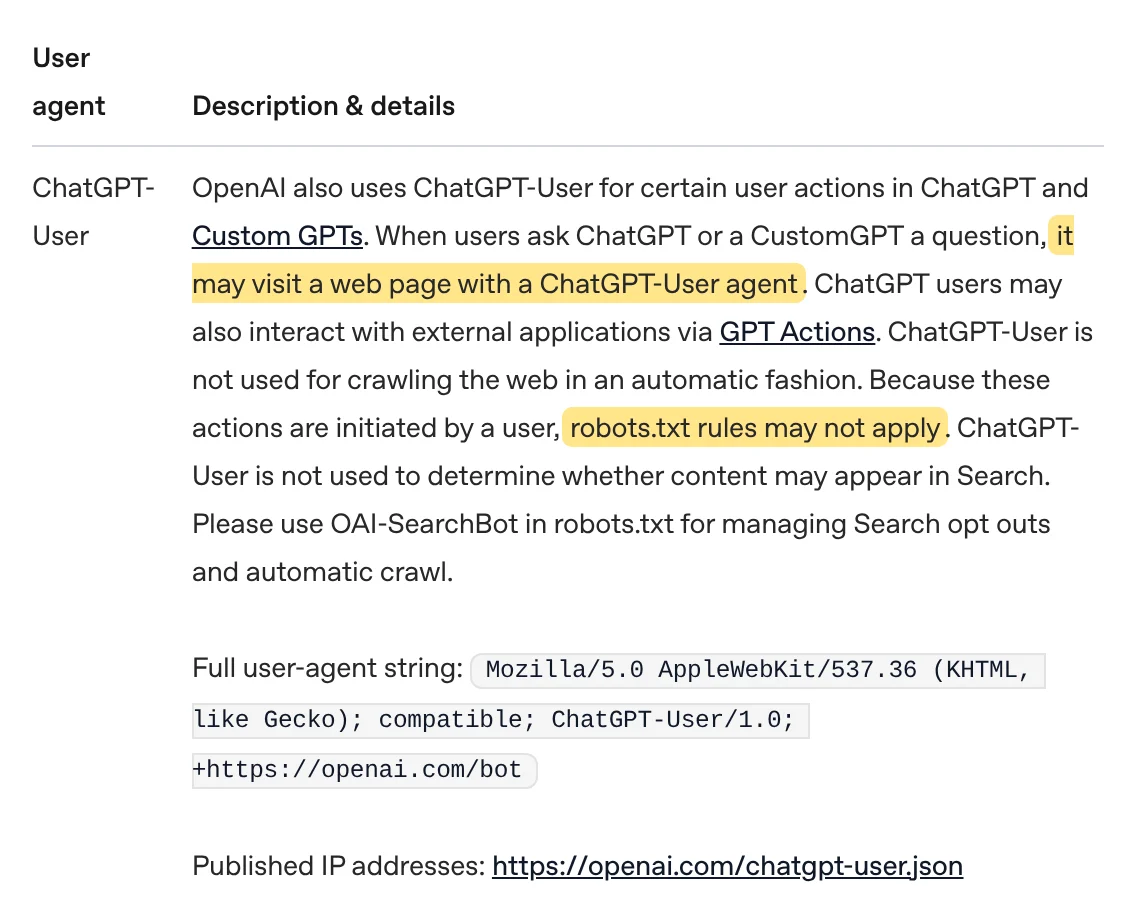
The search crawler OAI-SearchBot and the training crawler GPTBot each follow their own robots.txt group. In a study of AI search fetchers we covered, ChatGPT-User skipped robots.txt in testing.
#The publishers' fair use argument
The core claim is substitution. The brief argues RAG creates a "substitute for an original news article at the exact point of potential demand", when a user asks about the topic the article covers. It argues RAG is not transformative because it serves the same purpose as the article: delivering news to readers.
The publishers lean on the Third Circuit's 2026 ruling in Thomson Reuters v. ROSS. By their reading, copying expression to build a competing product is not fair use even when users never see the copy. OpenAI's side, as the brief describes it, is that harm from works that do not republish protected expression does not count. The publishers reply that OpenAI copied all or nearly all of each article's text.
Our read: a ruling here would speak to the live retrieval behind ChatGPT's answers with sources. Publishers and review sites, such as the Ziff Davis brands in this case, depend on the click a summary replaces.
#What to check
- Search your server logs for
ChatGPT-Useras well asOAI-SearchBotandGPTBot. A robots.txt disallow does not reliably stop the first one, so block it at your server or CDN if you want it out. - Before you block or allow by name, verify requests against OpenAI's published IP list at
openai.com/chatgpt-user.json. Our guide shows how to verify AI crawlers. - If you run a paywall, request an article as a logged-out bot and check whether the HTML still holds the full text behind it.
- Search for full copies of your articles on other domains. ChatGPT can ground on those copies, by the brief's account, and your robots.txt does not reach them.
#What the filing doesn't say
- How many times OpenAI copied the publishers' articles. The counts and the per-day estimate are redacted in the public version.
- How the Microsoft Bing route works. That section is redacted.
- Which OpenAI user agents fetched the 23 articles.
Sources
- News Plaintiffs' Memorandum of Law in Support of Their Motion for Summary Judgment on OpenAI's Infringement of News Plaintiffs' Content Used for Retrieval Augmented Generation and Outputs (Dkt. 2636, redacted)U.S. District Court, S.D.N.Y. (via CourtListener), November 25, 2026
- Order on News Plaintiffs' grounding and output claims (Dkt. 2518)U.S. District Court, S.D.N.Y. (via CourtListener), November 12, 2026
- Overview of OpenAI CrawlersOpenAI
- News publishers seek summary judgment against OpenAI over RAG, model outputsETLegalWorld, November 26, 2026 (reporting)