#A preprint tests how ChatGPT, Claude and Grok fetch pages
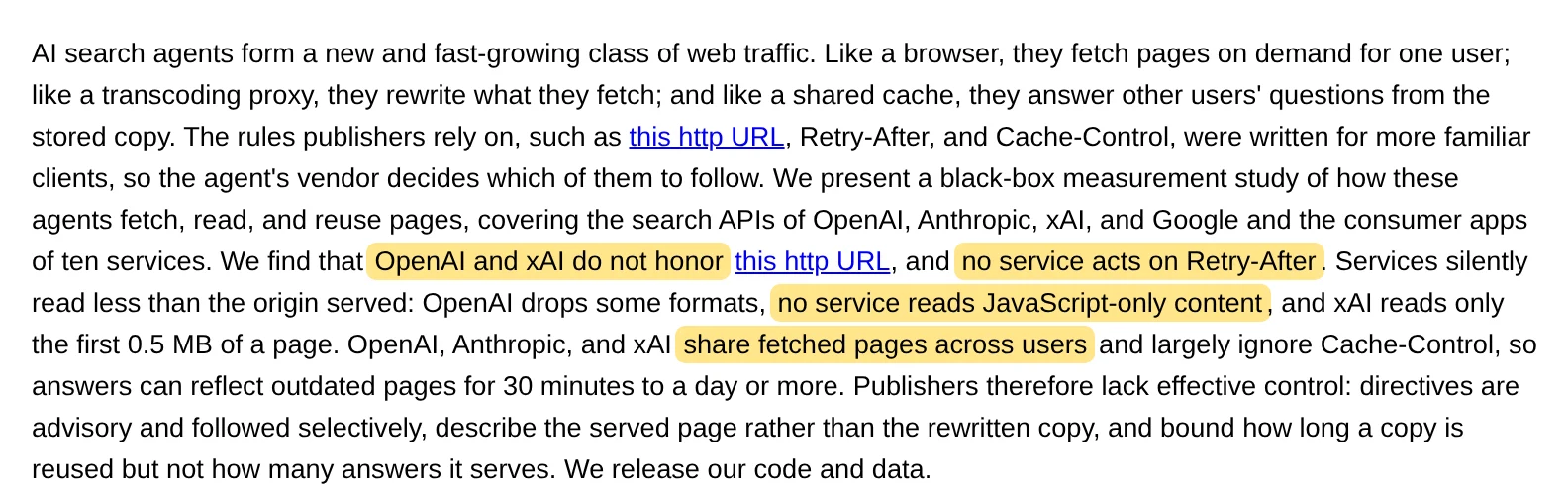
On November 23, 2026, four researchers from KAUST and LUMS posted Fetch, Read, Reuse, a preprint on how AI search tools fetch, read and reuse web pages. They tested the web tools of OpenAI, Anthropic and xAI on two test sites they run, checked two of the findings on public sites, and repeated some tests in ten consumer chat apps. The code and data are public.
#How the researchers matched each answer to a fetch
The API tests used OpenAI's gpt-5-mini and xAI's grok-4.3 through OpenRouter, and Anthropic's claude-sonnet-5 directly. The researchers checked that each request came from the vendor's own fetcher, not OpenRouter's. Google's Gemini API is in the public checks only, because on the test sites its answers didn't show whether its tool had read the page.
Each test page carried unguessable codes, so every answer could be matched to the request that fetched it. One test site sat behind Cloudflare with caching off, the other was served directly, and both allowed every crawler in robots.txt. Runs started between September 15 and November 10, 2026, with at least three runs per condition, from a server in Saudi Arabia. The public checks used 299 files (sitemaps, feeds and llms.txt), 90 homepages that change often, and 8 public counters that each service was asked about every 45 minutes for about three days.
#How ChatGPT-User, Claude-User and xAI's fetcher compare
| OpenAI | Anthropic | xAI | |
|---|---|---|---|
| User agent | ChatGPT-User | Claude-User | A macOS Safari or Chrome string |
| Requested robots.txt | No | Yes, before the first page | None seen |
| Requests per question (median) | 1 | 1 | 6, sent in parallel |
Waited for Retry-After | No | Did not retry at all | No |
| Formats used in answers | HTML, text, JSON, PDF | All 8 tested | All 8 tested |
| Text added by JavaScript or in a script block | Not read | Not read | Not read |
| Long pages | Read up to 2 MB | Read up to 2 MB | Read the first 0.5 MB only |
| Shared a fetched page with other customers | Yes | Yes | Yes |
| A page update reached answers after | About 30 minutes | A day or more | A day or more |
The Retry-After row also holds for Google and the consumer apps. In the paper's abstract, "no service acts on Retry-After."
#Why robots.txt doesn't reach ChatGPT-User or xAI's fetcher
ChatGPT-User never requested robots.txt, which matches OpenAI's own line that robots.txt rules "may not apply" to it. xAI's fetcher is harder to manage at all. It used 7,774 addresses for 8,286 requests, spread over about 1,260 networks, and in a hand check of 100 requests only 38 came from hosting providers. Our GrokBot profile notes that xAI documents no crawler name. With browser user agents on every request, a user agent rule has nothing to match.
Claude-User read robots.txt within a second before its first page request and read it again 60 to 70 minutes later. A new rule can take up to about an hour to reach it. In the consumer apps, only Mistral's Le Chat was seen requesting robots.txt before it fetched the page.
#Why JavaScript and JSON-LD never reach an answer
No service ran page scripts or requested an external .js file. Text that sat in the HTML inside a <script> tag, including a JSON-LD block, never appeared in an answer either. About 40% of the popular homepages the researchers checked embed JSON-LD. Our read: structured data still has its uses in search, but a fact that exists only in JSON-LD is invisible to these three tools.
OpenAI decided by the Content-Type header, not the content. The same bytes were used when served as text/html or text/plain, and refused as text/markdown, application/xml or text/csv. On public sites it refused 98% of XML files but read 95% of llms.txt files served as plain text. None of the fetchers the researchers could identify asked for Markdown, so Cloudflare's Markdown for Agents, which 12 homepages in the sample offered, was never triggered.
xAI downloaded whole pages but used only the first 0.5 MB, without saying so in the answer. The median public homepage the researchers measured was 158 KB. Our read: the cap hits long pages, such as big category listings or documentation, more than typical pages.
#How long an old copy lasts in ChatGPT, Claude and Grok
The paper compares these tools to a shared cache that answers "other users' questions from the stored copy". OpenAI, Anthropic and xAI answered one customer's question from a page fetched for another, even across models. Cache-Control made almost no difference. OpenAI fetched again after about 30 minutes whatever the header said, and xAI never fetched again within the 80-minute test. Anthropic ignored the header until October 15, 2026. From October 17 it fetched no-store pages fresh on every question, but still reused pages marked private or no-cache. No API fetcher sent a conditional request such as If-Modified-Since.
Even a fresh fetch didn't guarantee a fresh answer. After OpenAI fetched an updated page, about 60% of its follow-up answers still quoted the old version. On the public counters, median lag was close to zero for Google, about an hour for OpenAI, about eight hours for xAI and about eleven for Anthropic. 65% of Anthropic's answers about the 90 homepages came from a copy more than an hour old, and 7% from one more than a week old.
Failed fetches are remembered as well. When a page failed and was then fixed, Anthropic kept saying it was broken for the whole test window, up to about 11 hours. OpenAI sent no new request for about 25 minutes, and after that 70% of its answers still quoted the error. xAI picked up a fixed 503 or 403 quickly but not a fixed 404.
#Limits of the KAUST and LUMS tests
- The controlled tests ran on two new domains. Vendors may treat established sites differently, and the authors say so.
- The API budget was about $400, so pages over 128 KB were tested only sparsely.
- Most tests used the APIs with the models named above, not the consumer apps people use. In the apps, ChatGPT and Claude also shared a page across separate logins, and Grok did so in two of three runs.
- Behavior changed during the study, as Anthropic's
no-storeswitch shows. The authors call their results a snapshot.
#What to check
- If you want to keep
ChatGPT-Userout, a robots.txt rule won't do it. Use a firewall rule on the user agent and check addresses against OpenAI'schatgpt-user.jsonlist, as our verification guide explains. xAI's fetcher can't be singled out this way. - Open the raw HTML of your key pages (view source, not the browser inspector) and look for prices, product names, opening hours and specs. Anything you only see after scripts run is missing for all three tools.
- If you publish Markdown files for AI agents, check the
Content-Typeyour server sends with them. Our read: if ChatGPT matters to you,text/plainis the safer header for now. - Check the HTML size of your longest pages. If the facts that matter sit beyond the first 0.5 MB, Grok won't see them.
- To test whether a tool can read the current version of a page, ask about the URL with an extra query parameter such as
?check=2. All three fetched such a URL fresh. Avoidutm_names, which Anthropic strips. - Don't read a
ChatGPT-UserorClaude-Userhit in your logs as one answer. A single fetch can serve many customers, so log counts understate how often a page is used.
#What the study doesn't say
- What a fetcher does with a robots.txt that disallows it. Both test sites allowed every crawler, so the study shows who requested the file, not who obeys a block.
- How many answers one stored copy serves. The authors note that only the vendors can see that.
Sources
- Fetch, Read, Reuse: How AI Search Agents Bend the Web's Rules (arXiv:2611.30546)arXiv, November 23, 2026