#Perplexity adds a date cutoff to its Search and Context APIs
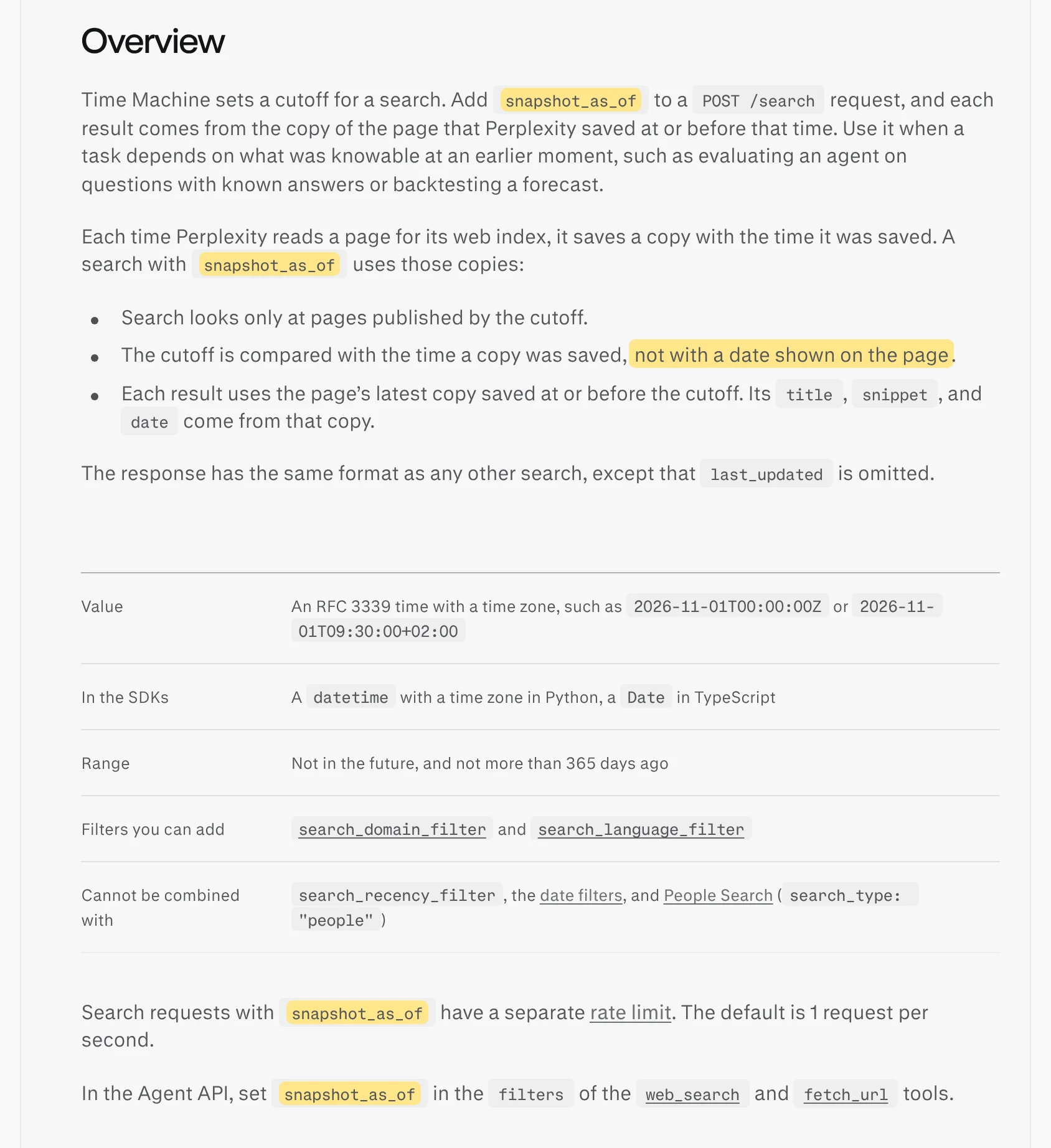
On November 25, 2026, Perplexity added Time Machine to its Search API and Context API. A new snapshot_as_of parameter limits results to the copies of pages that Perplexity saved at or before a chosen time, up to 365 days back. In the documentation, the cutoff is compared with the time a copy was saved, "not with a date shown on the page."
#What Perplexity keeps from each crawl
The announcement puts it plainly: "Each time Perplexity crawls a page, it saves a copy." So every URL builds up a version history. Our read: the crawler that feeds that index is PerplexityBot. Time Machine answers from that history:
| API | What a request with snapshot_as_of returns | Contact with your site |
|---|---|---|
| Search API | Pages published or first crawled by the cutoff, ranked on their older text, with title, date and snippet from that copy | None |
| Context API | The text of each page's latest copy saved at or before the cutoff, as Markdown | None |
Stored copies keep the page text but not its HTML or links. The Context API returns no content for a URL when it has no copy from that time, or when the page returned a 404 or 410 then. Our read: a page that you remove later still has its earlier copies, and a request with an earlier cutoff can read them.
The Context API already served stored copies without a cutoff. By default it returns a copy fetched in the last two days and fetches the page live otherwise. Developers can raise that limit to two years, and a stored copy comes back without any request to the site.
#Who reads the old copies
Perplexity's stated uses are evaluating and training agents on past questions, forecasting, finance backtests and replaying agent sessions. One use names site content directly: reading the same URL at two timestamps to see what a pricing page, terms of service or changelog said on each date, "for audits and disputes". Historical requests cost the same as other calls: $5 per 1,000 Search API requests and $1 per 1,000 Context API URLs.
Our read: ecommerce and SaaS sites, whose pricing and terms pages change often, and publishers that correct or update articles have the most old versions on record. None of this traffic reaches your server, so your logs show only the original crawl.
#What to check
- In your server logs, find when
PerplexityBotlast fetched your pricing, terms and policy pages. Our read: the latest of those fetches is likely the newest copy Perplexity holds of each page. - When you correct a mistake on a page, note the date and keep the old and new text, so you have your own record next to Perplexity's.
#What Perplexity doesn't say
- Whether blocking
PerplexityBotnow, or asking for removal, deletes the copies already stored. None of the three pages covers removal. - Which user agent the Context API uses when it fetches a page live.
Sources
- Freeze the web with Perplexity Time MachinePerplexity, November 25, 2026
- Time MachinePerplexity API documentation
- Formats and freshness (Context API)Perplexity API documentation